
A self-trial is a structured personal experiment you run inside the app. Use one when you want to test a change that matters to you — a new routine, a pacing strategy, a supplement, or another personal intervention — and actually find out whether it helps.
You are not joining anyone else's study. A self-trial is yours: your question, your measures, your timeline, your data.
Why structure beats a notes app#
Most of us have tried tracking a change in a notes app or a spreadsheet. It usually ends the same way: scattered entries, no clear end point, and a gut feeling instead of an answer. A self-trial gives you what those tools cannot:
- Repeated measures. The app collects the same measures the same way, day after day, so your data points are actually comparable.
- A defined duration. Your self-trial has a set length, so there is a real end point where you look at what the data says — instead of tracking forever and never deciding.
- Honest guardrails. The app reports results with guardrails, so a hopeful trend is not treated as proof. Three good days in a row feels like an answer; it usually is not one yet.
Your question, your primary measure#
You choose what to test and how to judge it. When you set up a self-trial, you pick the question that matters to you — “does this pacing strategy reduce my crashes?”, “does this supplement help my sleep?” — and the primary measure you will use to answer it.
Picking one primary measure up front is part of what makes the result trustworthy. It keeps you from unconsciously shopping around afterwards for whichever number happened to move.
Results that are honest about uncertainty#
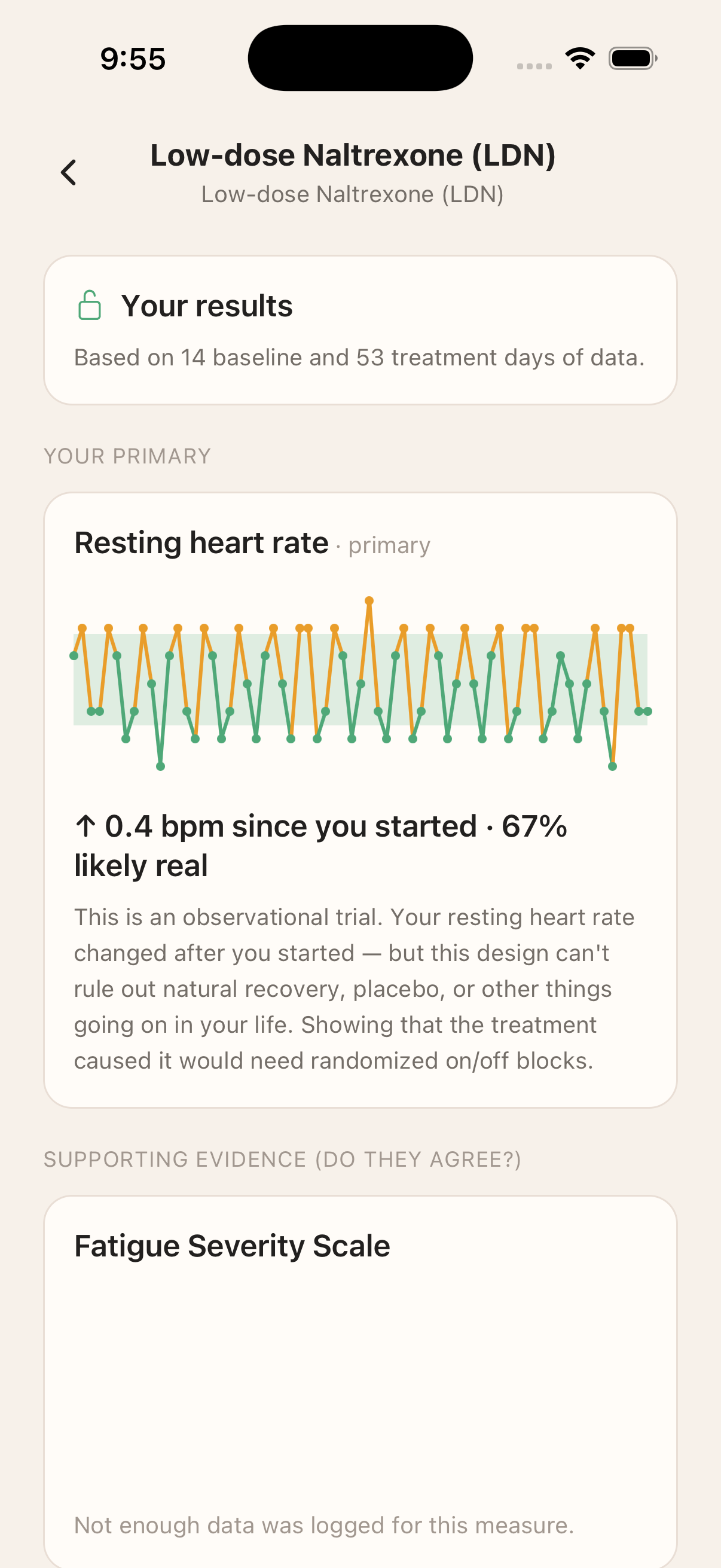
When your self-trial ends, the app reports what your data can support — and is explicit about what it cannot. If there is not enough data to say anything, the result says exactly that, rather than dressing up noise as a finding.
That can feel deflating, but it is the feature, not a flaw. An honest “not enough data” protects you from acting on a mirage. And missed days do not ruin a self-trial — gaps are expected, especially with energy-limiting illness, and the app works with the data you were able to give.
Self-trial results use the same honest approach as your study results — see Results and study history for how to read them.
Talk to your clinician before changing treatment
Private by default#
A self-trial is yours. It stays private unless you decide otherwise. When the option is available, you can choose to contribute aggregated, consented findings from your self-trial to the wider community — but that is always your decision, made explicitly, never a default.
For the bigger picture of what is and is not visible to anyone else, see Your data and privacy.