For researchers
Trial Signal, without breaking the blind
See the direction of a trial across check-ins, assessments, wearables, and specimens, with confidence intervals and arm comparisons where the design allows. Blinded teams stay blinded; completed studies can open the readout to the full team, and eligible studies can publish a privacy-protected public signal.
For patients
A complete study, right in the browser
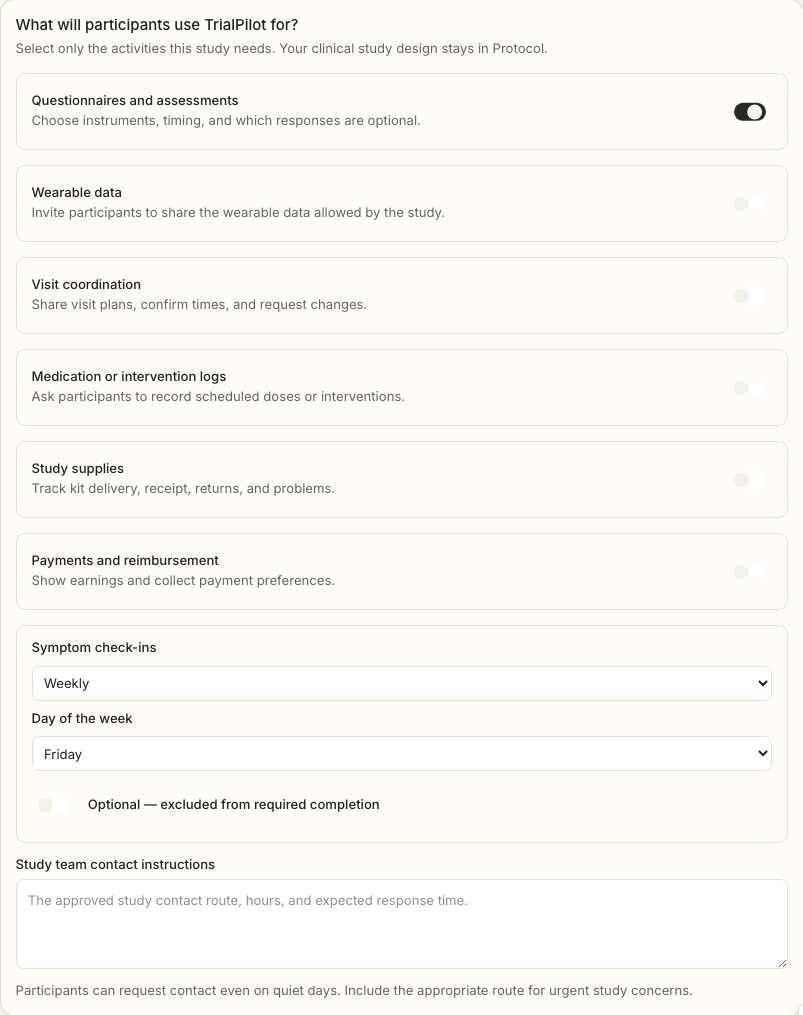
Browser-compatible studies can now run without an install, including consent, check-ins, assessments, reports, and completion. TrialPilot clearly identifies tasks that require the mobile app, while wearable data already synced by a phone remains available as familiar trends on the web.
For patients
From finding a study to crossing the finish line
Browse studies you can join, scan a channel-specific recruitment QR code, choose whether to share wearable data, and start when your plan is ready. The study calendar shows what happened each day and marks the finish without turning missed work into shame.
For researchers
A Study Builder that shows the way forward
Move through clear planning, setup, and launch stages with participant burden visible while you design. Launch review groups every missing requirement and takes you directly to the section that needs attention.
For researchers
Single-timepoint specimen studies, end to end
Run kit-based and biospecimen studies without forcing them into a daily adherence model. A shared journey now covers activation, collection, chain of custody, lab accessioning, result ingest, consent over stored samples, and appropriate result return.
For patients
A health timeline built around real life
Track symptoms that matter to you, including your own labels, and record illnesses and vaccinations as they happen. Gentle, research-backed attention signals can surface meaningful within-person changes, while study teams only receive the de-identified context their study is allowed to use.
For researchers
Remote eligibility, without the privacy tradeoff
Participants can screen from home. Criteria that need a coordinator stay pending until staff verify them, while answers and identity remain on the participant side of the privacy boundary.
For patients
Study supplies that come to you
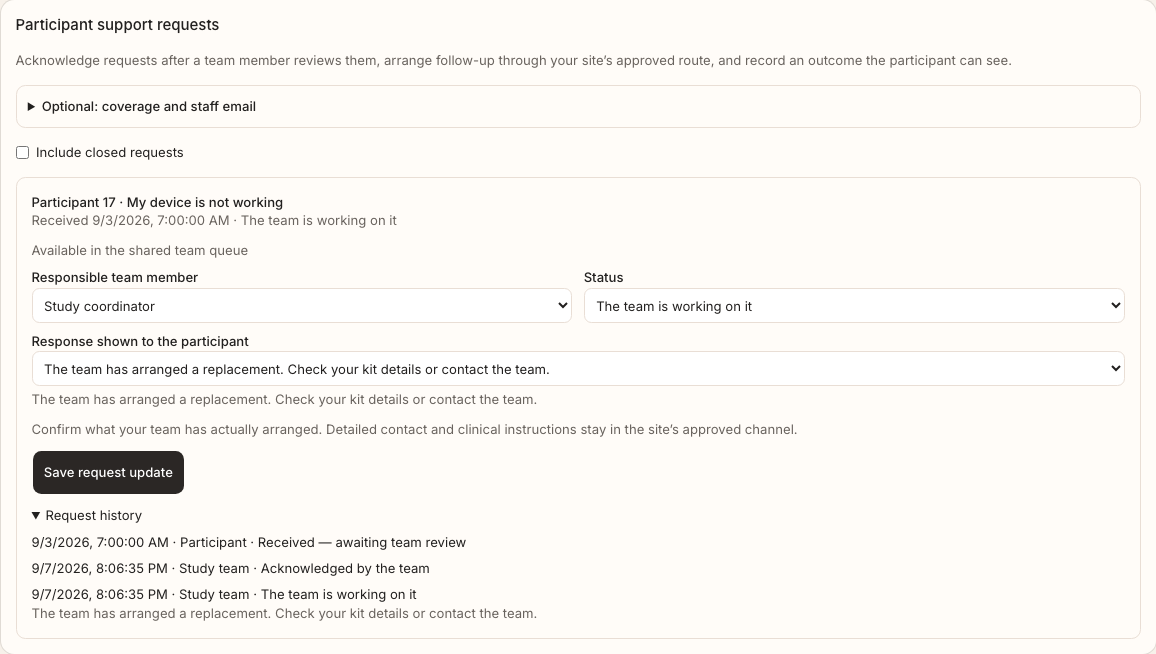
Track a study kit, report a damaged delivery, and confirm receipt with the kit code from the app. Research teams get the accountability trail they need through return or final disposition.
For researchers
Risk-based monitoring in one view
Write the monitoring plan, track deviations, and review six live risk indicators without crossing the blinding or identity boundaries. Thin data stays “not enough data,” never a false alarm.
For patients
A real voice before the protocol is final
Review a short, plain-language protocol digest and rate what feels workable. Feedback is pseudonymous, optional, and hidden from research teams until enough people respond.
For researchers
From startup checks to a verifiable archive
Launch readiness, protocol versions, trial-registration clocks, milestones, reconciliation, audit inventory, and closeout now form one governed path from draft study to hash-stamped archive.
For researchers
An inspection package that knows what it contains
The unified audit export carries a machine-checked inventory across every study-scoped audit domain, with de-identified participant events and blinding-safe unblinding records.
For researchers
Regulatory activation & IRB oversight
No enrollment or randomization without a current IRB approval bound to the exact protocol and consent versions it covers. Generate submission packets from structured data, and track amendments and reportable events in one regulatory hub.
For researchers
Randomization & blinding
Permuted-block, minimization, uploaded-list, or simple randomization for everyday RCTs and crossovers, with open, single, and double-blind modes, a code-versus-arm firewall, and an audited emergency unblind.
For patients
A baseline that banks itself
Wearable data can start collecting before you enroll, and recent coverage waives the baseline wait when a study begins. A configurable baseline window and wearable sync-health surface gaps early.
For patients
eConsent, made humane
Accessible, resumable informed consent with gentle comprehension checks, an electronic signature workflow, and a countersigned PDF receipt. Consent that respects a hard day and can be re-read anytime.
For researchers
Adaptive platform trials
A perpetual, multi-arm protocol with deterministic randomization, response-adaptive allocation inside preset guardrails, factorial domains, and a blinding firewall that keeps interim looks away from the people who shouldn’t see them.
For researchers
Electronic data capture + CDISC export
A versioned, audited dataset with an edit-check engine and query workflow, coding review (licensed dictionaries are not connected in the preview), soft and hard database lock with audited unlock, and one-click CDISC SDTM + define.xml export.
For patients
Pacing & readiness
A within-person heart-rate ceiling, time-over-threshold, an orthostatic-aware POTS split, and a morning readiness read from resting HR and HRV — framed as a pattern, never a prediction. Quiet by default.
For patients
Patient-led self-trials
Guided single-case (n-of-1) studies with on-device single-case experimental design and segmented-regression analytics, a primary endpoint you choose, and an honesty layer that won’t let a hopeful trend pose as proof.
For patients
Study results & history
A calm, within-person Green / Yellow / Red read of your own measures — never red on missing data — plus a unified history of every study and self-trial you’ve run.
Safety
Objective PEM capture
Post-exertional malaise detected from ordinary participation — check-ins plus wearable data — against a versioned, patient-anchored definition, with a tap-only enrichment flow.
For patients
Gentle investigator nudges
A coordinator can queue a one-way, templated check-in that arrives as a considerate local notification — rate-limited, never stacking, and silent when someone is unwell.
Safety
Adverse-event safety & escalation
A reporter-not-actor model so the person who notices a safety concern isn’t forced to act, with review routing and a privacy boundary between identity and clinical data.