Skip to content

The platform

Built for the people who run trials, and the people who live them.

Enrollment, wearable data, safety monitoring, adaptive designs, managed data capture, and patient-led self-trials — the entire study on one platform. Here's what's inside.

DecentralizedOffline-ready actionsWearable dataPEM capturePacing & readinessSafety reviewPatient-led self-trialsAdaptive platform trialsEDC & CDISC export

Currently in preview. Product screens are illustrative; availability depends on your app version and study setup. Upcoming features remain labeled below.

One source of truth

One study, two points of view.

Researchers get a study workspace. Participants get a calm, guided app. Their records connect as data synchronizes, with role-based access and context about freshness and missing observations.

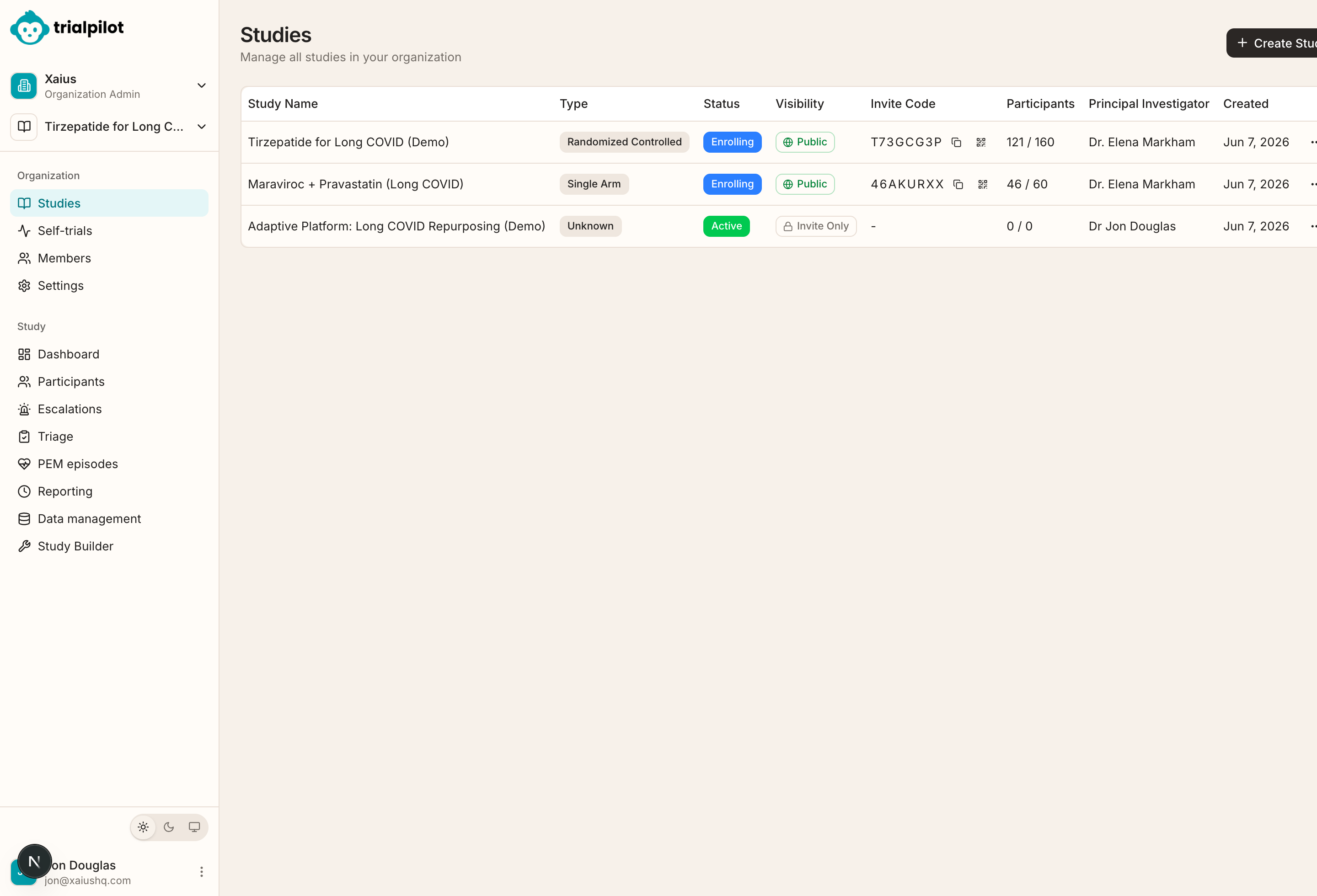
The organization studies dashboard
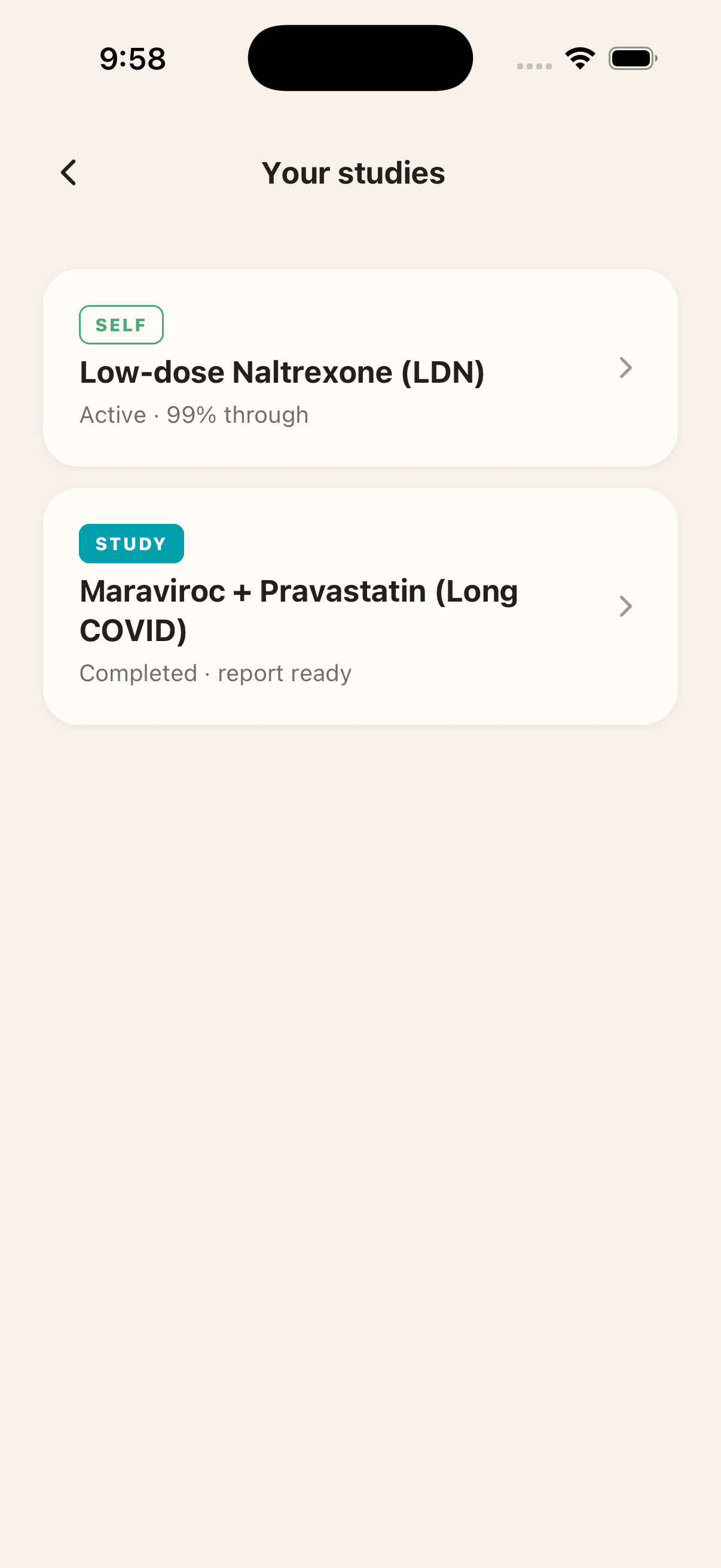
A participant's own studies list in the TrialPilot app

Left: the researcher's organization view — every study, its enrollment, and its principal investigator at a glance. Right: the participant's own studies and self-trials. Same data, two roles.

01Participation built for real life

The trial fits the participant. Not the other way around.

Good data starts with an experience people can actually live with. TrialPilot protects progress, handles supported work through weak connections, and makes the next step clear.

Participant experience preview
Save your place

Pause when you need to

Save progress in supported assessments and resume within the study window. Check whether work is saved locally or has been received by the study.

Weak connections

Keep going when the signal drops

Supported mobile check-ins, symptom reports, self-trial updates, and study actions can queue for synchronization. Check the saved or pending status; browser and security-sensitive actions have separate connectivity requirements.

Clear guidance

See what's saved. Know what's next.

TrialPilot shows when your work is saved or waiting to sync, then gives you a clear way forward if something needs attention.

An assessment with progress, a primary Continue action, and Save and finish later
A participant's study and self-trial list

Some moments should never be guessed at. Consent and security-sensitive actions stay online-only, with clear guidance instead of silent retries.

Everyday participation: capabilities and availability

Browser-compatible participation
Complete supported consent, check-ins, assessments, and reports in the browser. The study identifies activities that require the mobile app.
Assessments that save your place
Pause supported questionnaires and return to your saved progress.
Supported offline capture
Queue supported check-ins, symptom reports, and study actions for synchronization. Consent and security-sensitive actions require a connection.
Study links and screening
Open a study from its link or QR code, review eligibility and consent, and follow the enrollment process.
Visit coordination
View scheduled visits, confirmation requests, and the joining instructions your study team provides.
Kits and compensation
Review recorded shipment, receipt, and study-payment states. These records do not imply automatic courier dispatch or payment settlement.
02Decentralized by design

Bring study activities closer to people.

A participant’s address should not be the only factor in reaching research. TrialPilot supports remote activities, check-ins, and health sharing; study eligibility, visits, equipment, and support arrangements still determine how someone can take part.

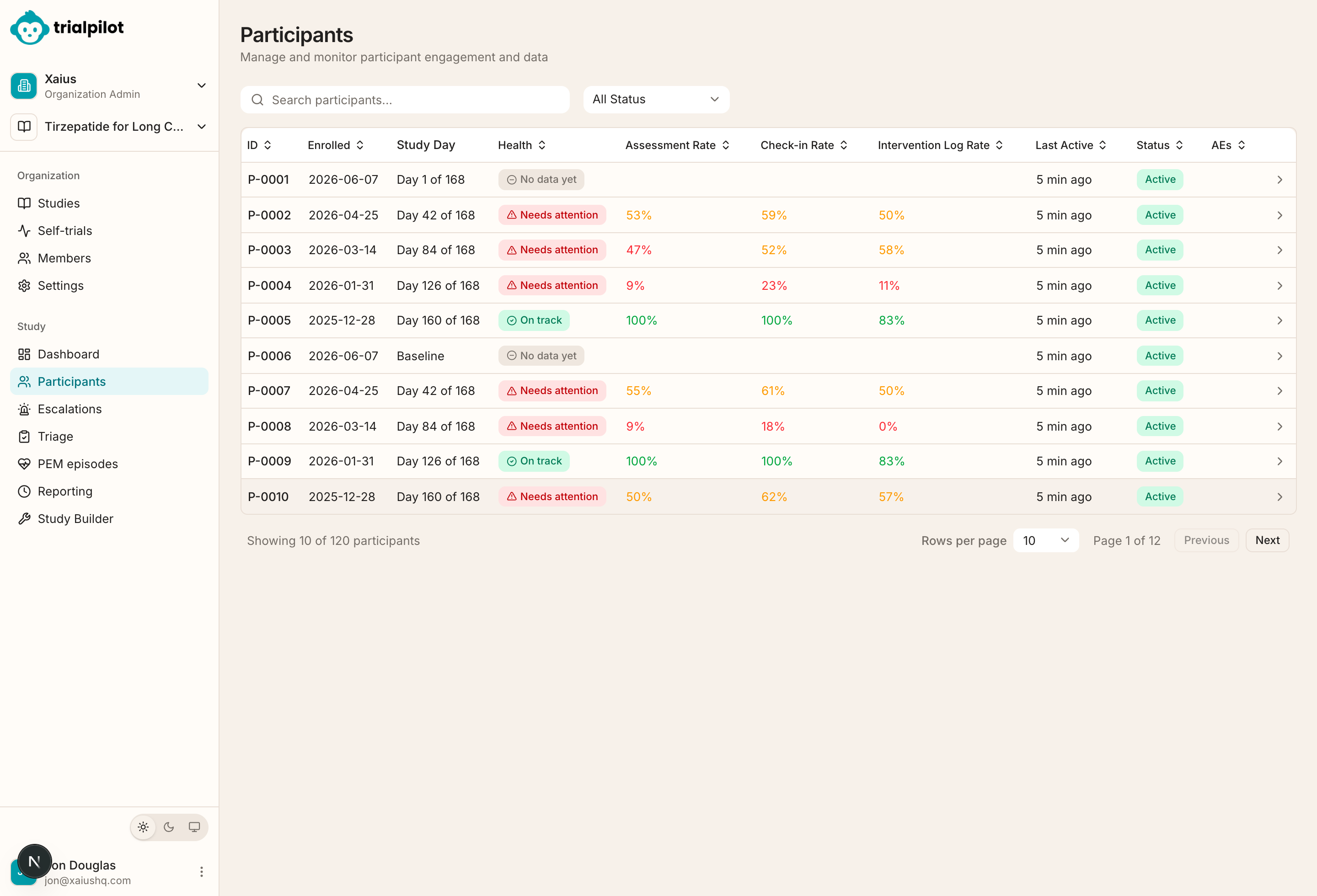
The participants dashboard with assessment and check-in rates
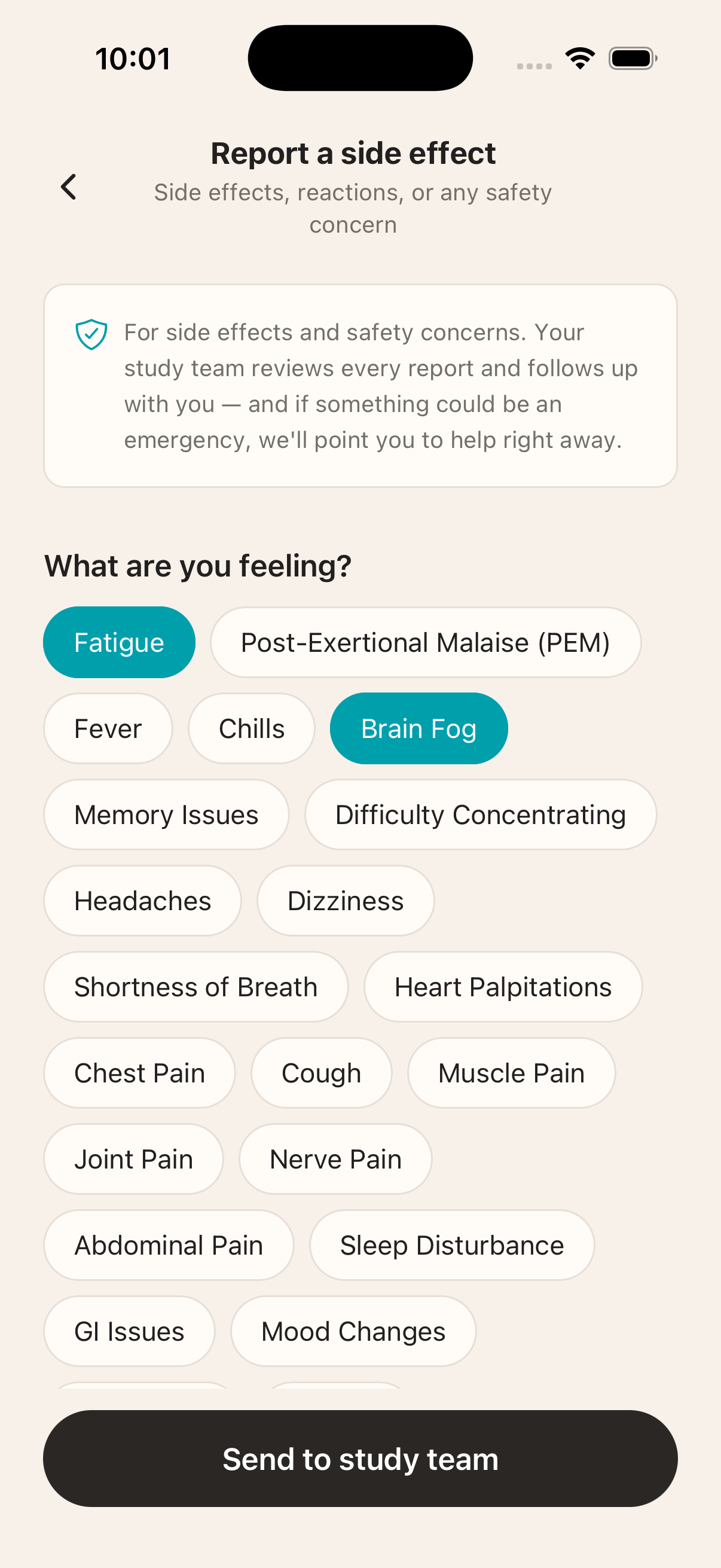
A participant reporting symptoms from home on their phone

Left: the coordinator watches assessment and check-in completion across the whole cohort. Right: the participant capturing symptoms from home — the moment that fills those columns.

Wearable data

The real world, continuously

Collect supported vital, activity, and sleep records through Apple Health and Health Connect, alongside symptom reports. Coverage and freshness depend on the device, permissions, and synchronization.

Retention

See changes in participation

Review completion, engagement, and missing-data patterns to plan coordinator follow-up. These signals help identify questions; they do not establish whether someone will drop out.

Remote monitoring

Meet patients where they are

Asynchronous check-ins and supported health sharing let participants complete eligible activities at home. Study teams determine how information is reviewed and followed up.

Representative cohorts

Studies that look like the world

Use study criteria, self-screening, and coordinator review to evaluate eligibility. Combine outreach with practical participant support; measure representation rather than assume it.

Global access

Research without borders

Offer eligible activities closer to rural and underserved communities. Locations, approvals, language, equipment, and support still need to be planned for each study.

Enrollment

One link. One scan. A way to join.

Share a link or QR code in an email, post, or flyer. Participants review eligibility and consent, then follow the enrollment process. Keep the study code when an app install is needed.

Data between visits: capabilities and availability

Apple Health and Health Connect
Share supported health records with permission. Available measurements depend on the device, permissions, and synchronization.
Symptoms and assessments
Collect scheduled questionnaires, symptom check-ins, and intervention logs with their study context.
Within-person trends
Review changes against a participant’s own baseline, with data-availability context.
Personal health timeline
Record symptoms, illnesses, and vaccinations as context for changes over time. Study access remains governed by permissions and de-identification.
Assessment heart rate
Keep device, manual, and corrected readings distinguishable in supported physical assessments.
03Safety & real-world physiology

The body keeps the data. We help you read it.

Review everyday health records alongside participant reports to explore within-person patterns. These tools are designed with energy-limiting and complex chronic conditions in mind; they do not diagnose a condition or replace clinical review.

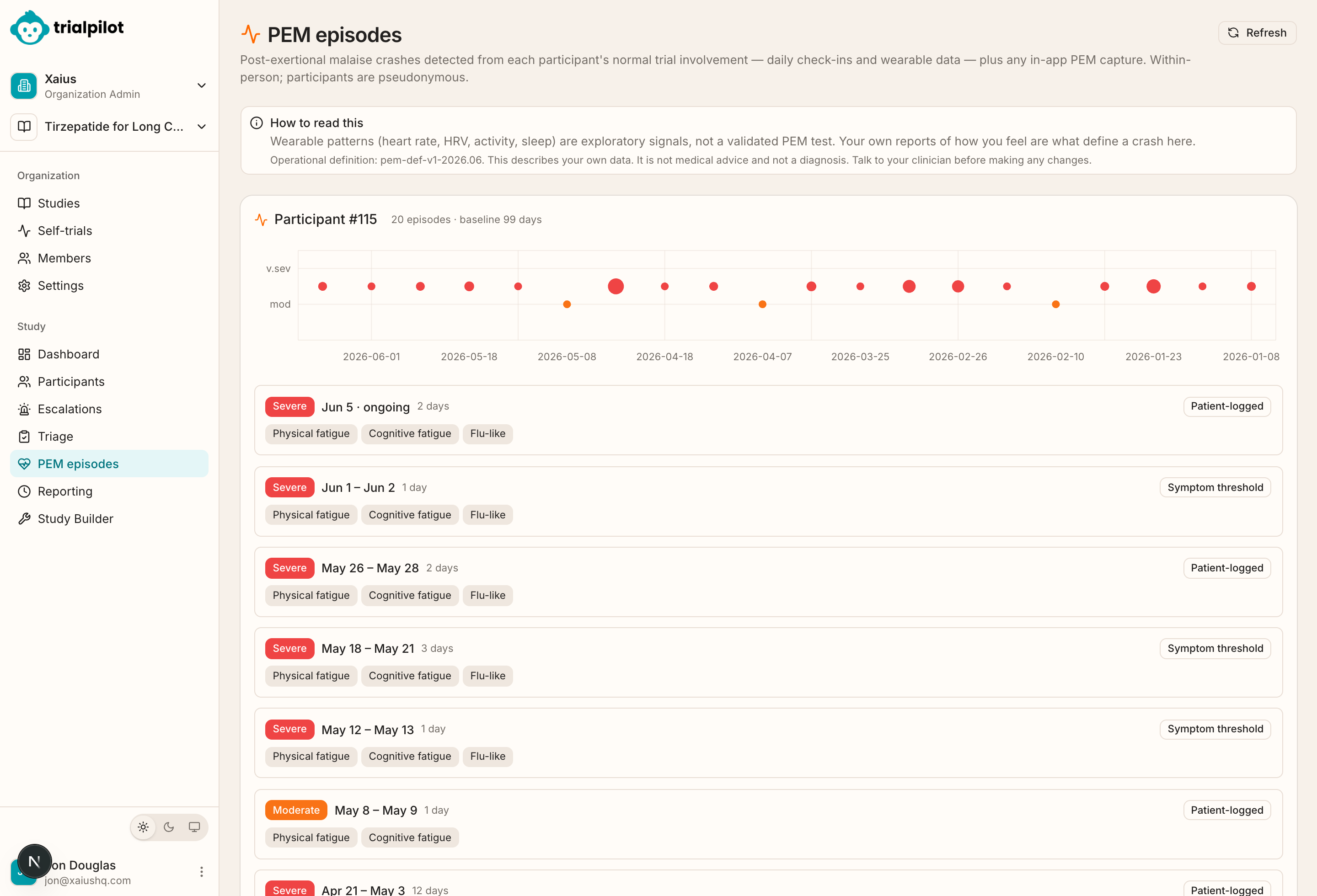
The researcher's PEM episode timeline
A participant's pacing self-trial timeline with daily check-ins and assessments

Left: the researcher's PEM episode timeline, built from ordinary check-ins and wearable data. Right: the participant's pacing self-trial timeline, keeping daily check-ins and assessments together.

Adverse events

Escalation that respects the patient

Record a safety concern and route it for review by the people responsible under the study’s procedures. Reporting and resolution are separate responsibilities, with permissions and a record of follow-up.

Real-time alerts

Review concerns between visits

Bring participant reports and available health observations into review between scheduled visits. Staff coverage and study procedures determine response times; this is not an emergency service.

PEM capture

Capture post-exertional patterns

For ME/CFS and Long COVID studies, combine check-ins and supported health records to explore post-exertional worsening against the study’s definition. A participant report adds personal context; a detected pattern is not a clinical diagnosis.

Pacing & readiness

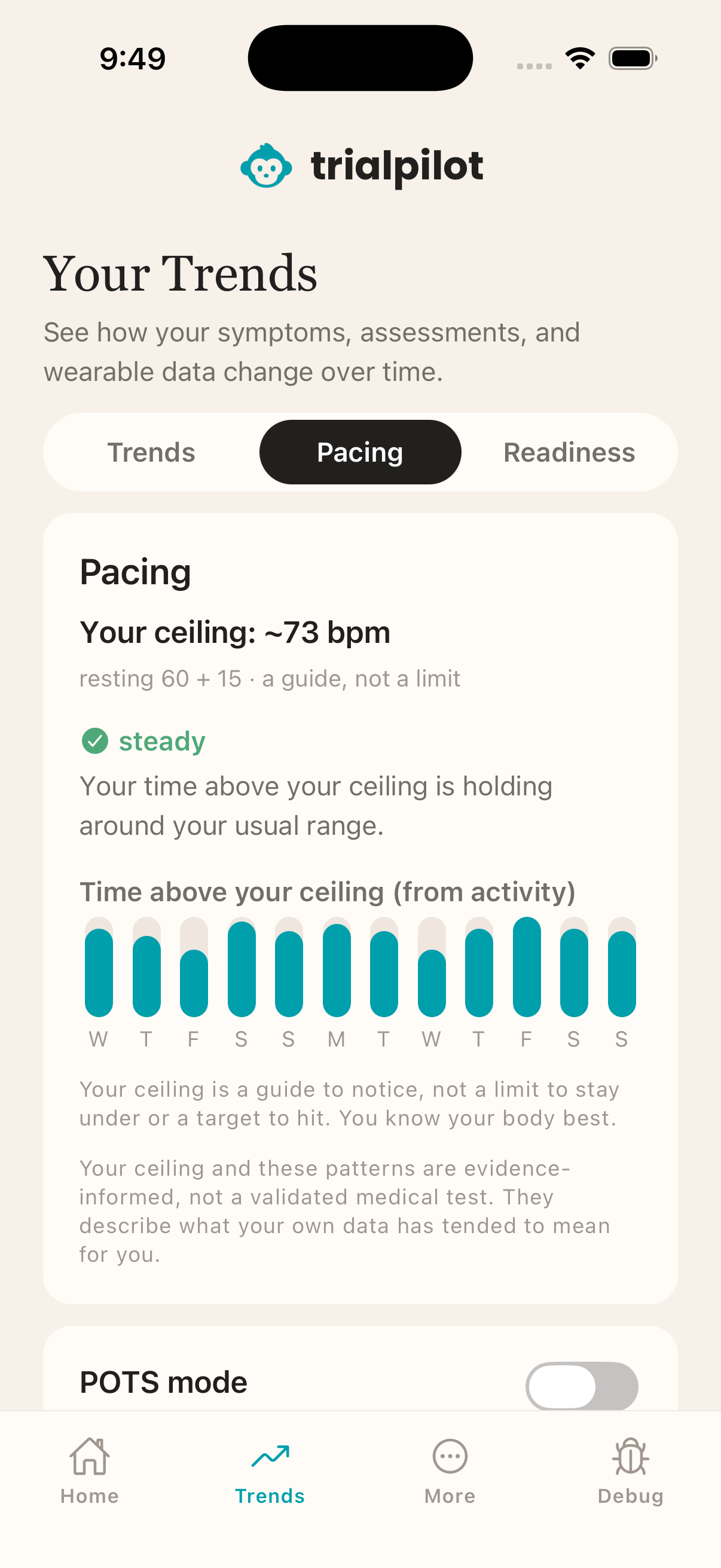
Your envelope, not a generic target

Review personal heart-rate thresholds, time over threshold, and available resting-heart-rate and HRV context. Interpret pacing and orthostatic patterns with your clinician; they are not exercise targets or a prediction of how you will feel.

Assessment HR

Heart rate during physical tests

Capture beat-by-beat heart rate through assessments like the NASA Lean and sit-to-stand, with per-value provenance — device, manual, or corrected — that always keeps the original reading for a defensible record.

Gentle nudges

A check-in, never an alarm

Supported coordinator check-ins use one-way templates with delivery limits and expiry. Notification settings, device permissions, synchronization, and study configuration affect whether a reminder appears.

Safety and participant context: capabilities and availability

Adverse-event workflows
Record concerns, review events, track reporting obligations, and retain the history of decisions.
Escalation queues
Route concerns for review under the study’s procedures. This is not an emergency service or a guarantee of continuous clinical monitoring.
PEM and pacing tools
Combine symptom reports and supported wearable data to explore post-exertional patterns and personal pacing context. These tools do not diagnose a condition.
Engagement monitoring
Review completion and missing-data signals to guide follow-up. Signals do not establish that a participant will drop out.
04Patient-led science

Give patients a rigorous trial of their own.

Some people can't wait for the next big study. Self-Trials bring real single-subject methodology to them — without pretending an n-of-1 is something it isn't. They design it, run it, and read the result, right from the app.

A participant's self-trial results in the TrialPilot app

A structured single-subject study

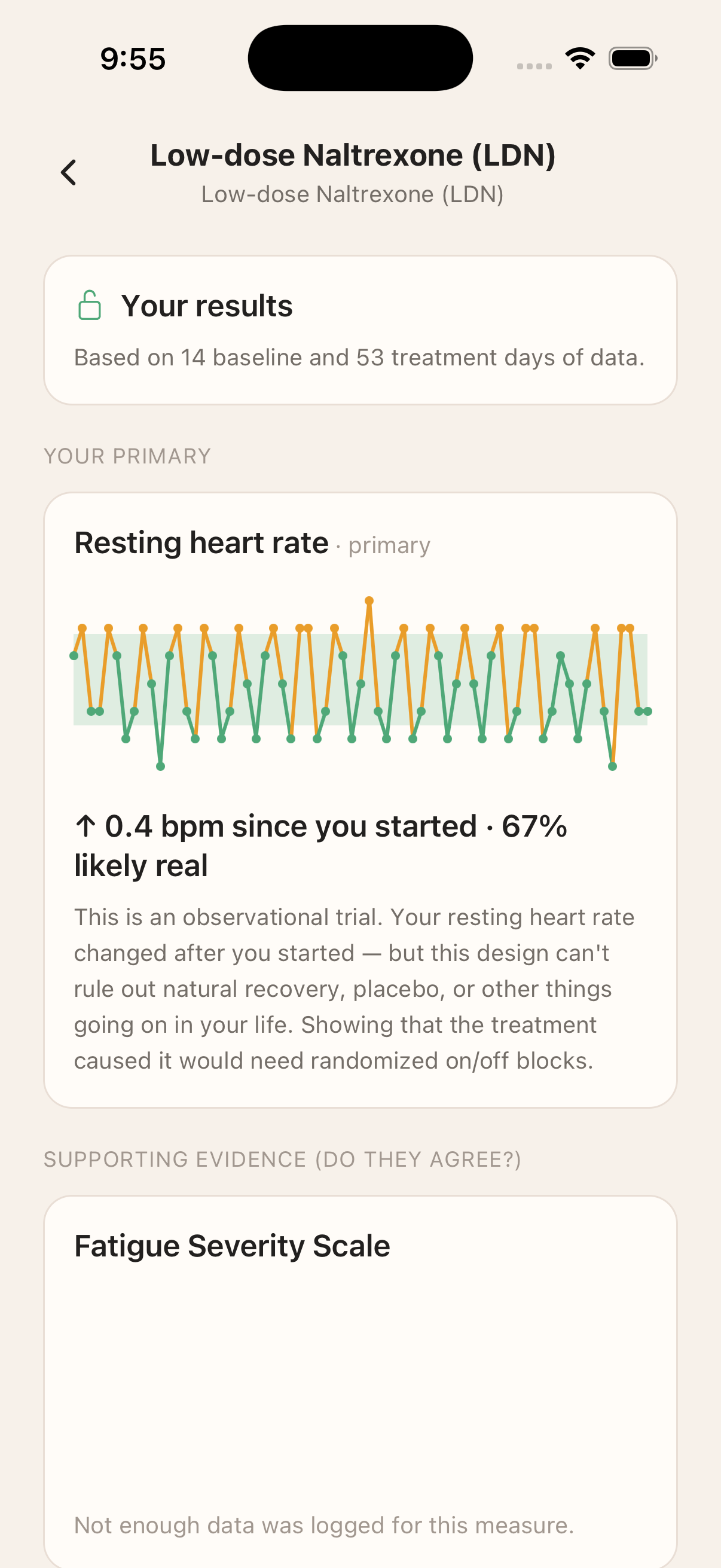
Guided single-case studies pair repeated observations with on-device single-case and segmented-regression analysis. The method and available data determine what an estimate can support.

You pick what matters

Choose your own primary endpoint — fatigue, cognition, autonomic symptoms — as a primary, secondary, or exploratory measure, over a duration you commit to up front.

An honesty layer, built in

Data-sufficiency indicators and provisional early signals keep uncertainty visible. A promising trend still needs careful interpretation and does not establish treatment effectiveness.

Read a result with its context

Review within-person summaries alongside missing observations, data quality, and prior self-trials. Follow the study’s reporting instructions for safety concerns.

Share — or don’t

Choose the sharing options supported for your personal self-trial. Review those choices separately from the consent and data obligations of any investigator-led study you join.

Lived experience becomes evidence

Shared, consented observations can help frame questions for further research. Aggregation does not remove bias or make a personal experiment equivalent to a controlled clinical trial.

Participant-led self-trials: capabilities and availability

Define a question
Choose measures and a study duration before collecting observations.
Track and review
Follow your observations and within-person analysis in the app. Early signals are presented with uncertainty.
Keep perspective
A personal experiment can inform a conversation with your care team. It does not establish that a treatment is safe or effective.
05Research operations

The serious machinery, handled.

Decentralized doesn't mean less rigorous. Underneath the calm app is the full apparatus a modern trial needs — adaptive designs, clean data, coding, locks, and exports — so your team can spend its time on the science instead of the plumbing.

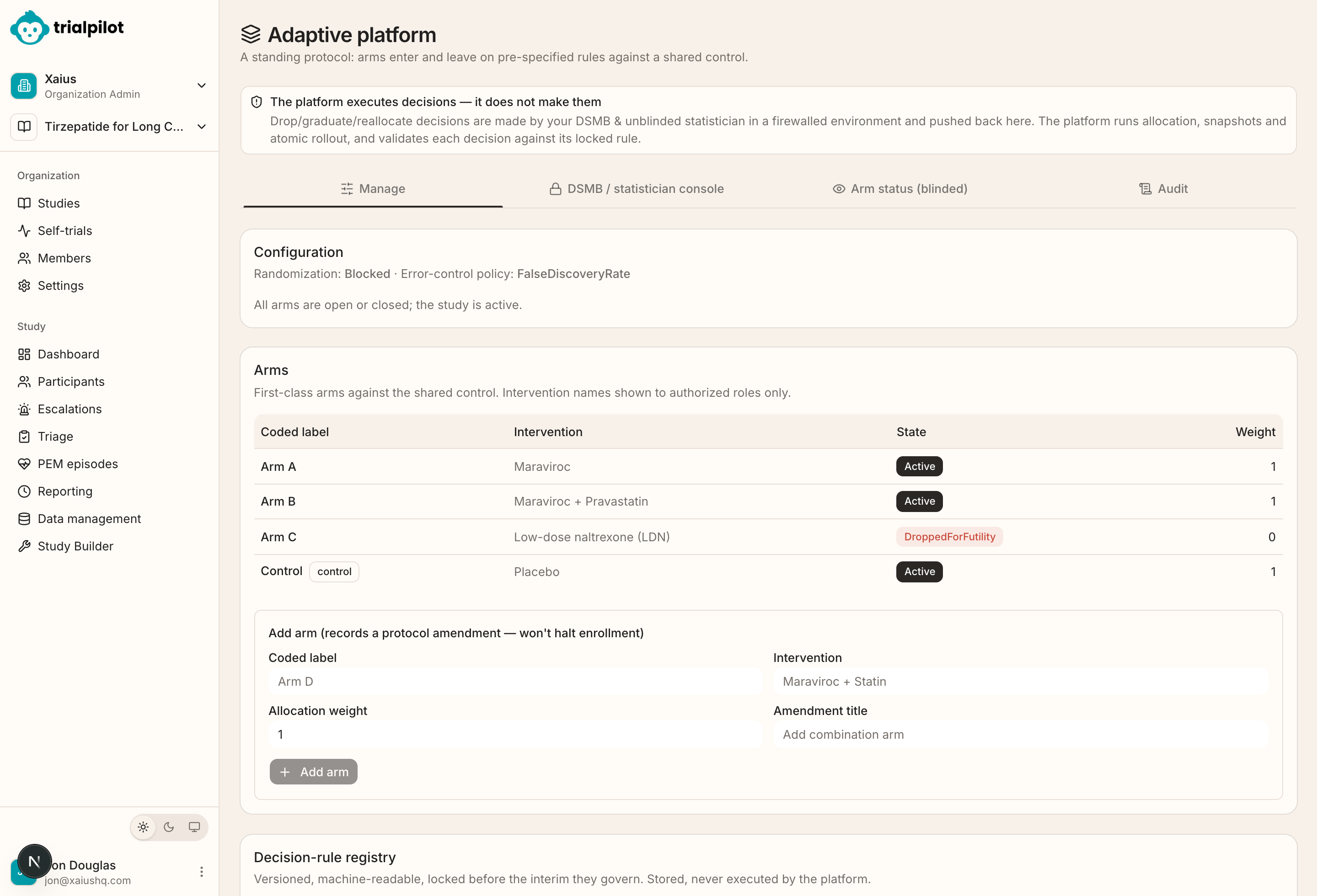
The adaptive platform console showing arms against a shared control
Adaptive platform: arms enter and leave against a shared control, with a blinding firewall around every interim look.
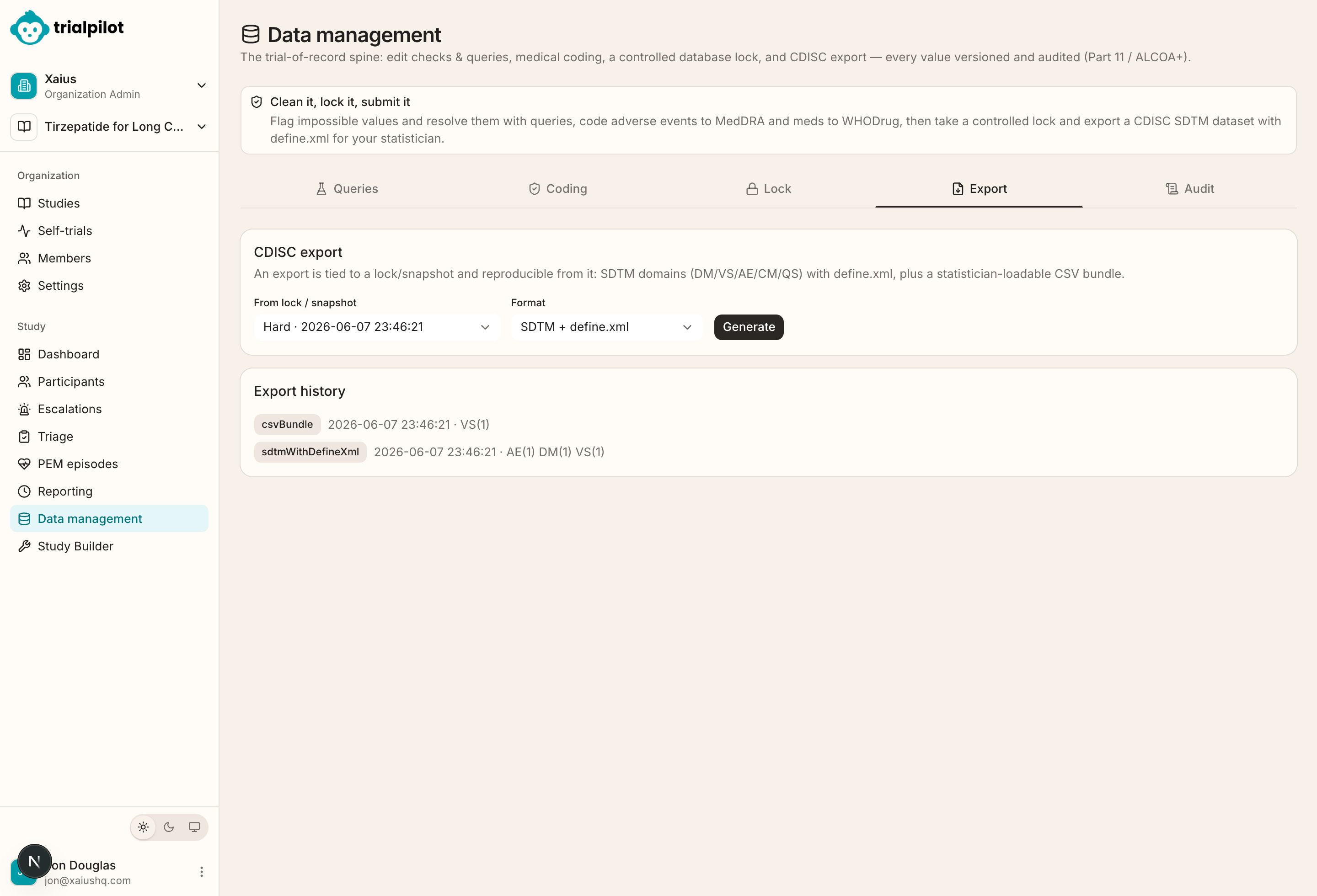
The CDISC export screen with SDTM domains and define.xml
CDISC export: SDTM domains + define.xml, generated from a controlled database lock.
Adaptive platform trials

One protocol that keeps learning

Run a perpetual, multi-arm protocol with deterministic randomization, response-adaptive allocation inside preset guardrails, factorial domains, and a blinding firewall that keeps interim looks away from the people who shouldn't see them.

DSMB packages

A DSMB process you can show a regulator

Every interim look is frozen and hashed. The statistical analysis center builds an open and a closed report from it, the DSMB records its recommendation against them, and each step traces to the same bytes. The people who prepare the analysis never vote on it.

Adaptations

Change the design inside limits set in advance

Re-estimate an arm's sample size or enrich enrollment to the patients who benefit, only within bounds written into a locked rule. New arms go through the IRB first, and first-in-human arms start with gated sentinel cohorts.

Sites, decentralized first

Home by default, a clinic only when it has to be

Add sites for the visits home can't do, like a scan or an infusion, and say why each one needs a clinic. Every participant gets a site of record, and risk and enrollment are tracked by site.

Arm sponsors

Several companies on one platform, kept apart

Each sponsor sees only its own arms, from its own organization, and never an interim result. When its arm leaves the platform, it receives a frozen data package with its arm and concurrent controls only.

Operations you can measure

Know how fast, how accurate, and how much

Data collection time, cleaning time, decision turnaround from each interim cut, dataset build time, enrollment forecasts by site and arm checked against reality, and cost per arm from an append-only ledger.

Safety reconciliation

The safety database and the dataset agree

Serious adverse events are compared between the safety workflow and the trial dataset before lock. Every disagreement becomes a query, and a missing event can be copied across with its source recorded.

Electronic data capture

A clean dataset, by construction

A versioned, fully audited managed dataset with an edit-check engine and a query workflow — discrepancies get caught and resolved in the flow, not in a spreadsheet three months later.

Coding & queries

Coding review, with dictionary connections

Review coded terms and tracked queries with an attributable history. Licensed MedDRA and WHODrug dictionaries are not connected in the preview; supplying and validating those connections is separate work.

Lock & export

Database lock and CDISC export

Use soft and hard database locks with audited unlocks, plus supported CDISC SDTM and define.xml generation. Validate mappings and outputs for your protocol and intended submission.

Integrations

Fits the stack you already run

Plan connections to research tooling around available APIs and exports. EHR, laboratory, and vendor integrations require separate scoping and validation.

Privacy by architecture

Identity separated by default

Participant identity lives apart from clinical data at the database boundary. De-identified coordinator views and study-scoped permissions define how teams access research records.

Study operations: capabilities and availability

Study Builder and protocol versions
Configure study design, assessments, eligibility, consent, and visits. Track protocol versions and startup checks.
Draft-study sandbox
Invite approved team members to test a draft study on real devices before publication. Test enrollments and their records are marked separately from real participation.
Trial Signal
Review study-level signals with uncertainty and data-availability context. Access follows study blinding; public signals require eligibility and explicit publication.
Specimen studies
Coordinate supported collection, chain-of-custody records, lab accessioning, result ingest, and appropriate result return for single-timepoint studies.
Recruitment and registries
Manage recruitment channels, eligibility review, and registry cohorts with study-scoped permissions.
Randomization and platform trials
Configure supported allocation methods, blinding, and platform-trial rules within the study’s approved design.
Monitoring and supplies
Track risk indicators, deviations, review records, kits, delivery exceptions, and reconciliation.
Managed data and exports
Use edit checks, tracked queries, database locks, audit exports, and supported CDISC SDTM / define.xml generation. Validate outputs for your intended use.
Coding review workflow
Review and approve coded terms. Licensed MedDRA and WHODrug dictionaries are not connected in the current preview.
Regulatory records and closeout
Organize approvals, amendments, reporting obligations, completion checks, and archive records.
De-identified coordinator views
Study teams work with study-scoped participant identifiers. Direct participant identity is separated from the coordinator API.

Coming next

More flexibility. Less to keep track of.

A look at the next participant experience. These features are in development and are not yet released.

01 / COMING NEXT

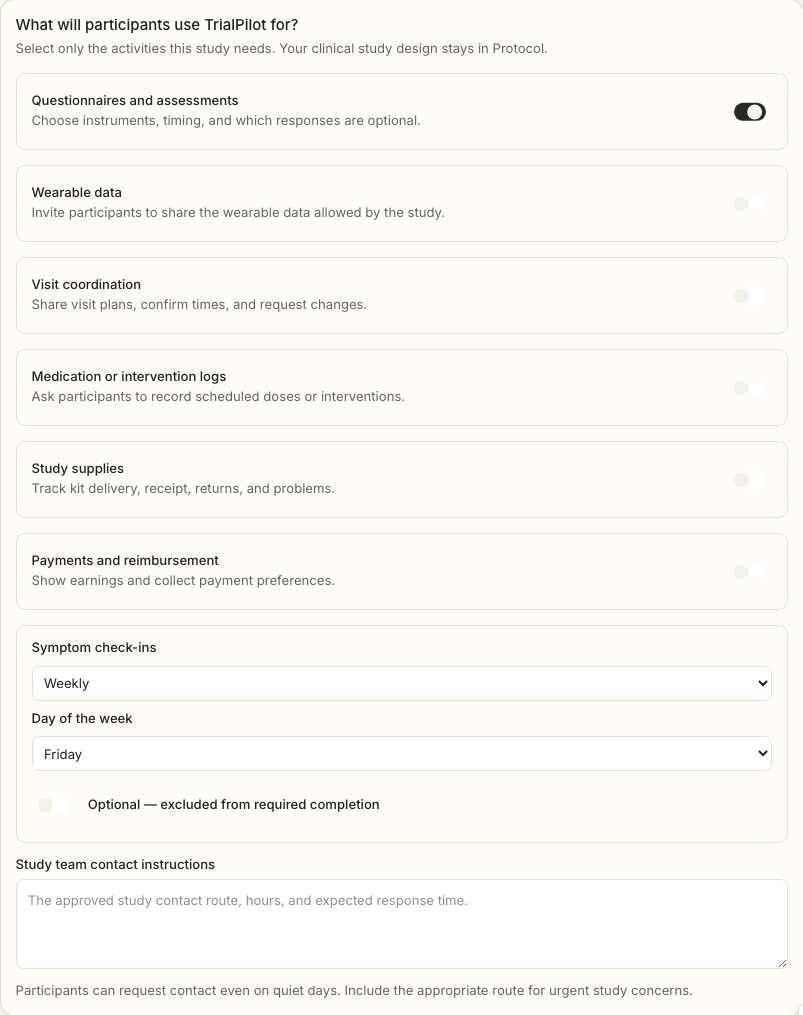
Choose the activities your study needs.

Configure questionnaires, check-ins, wearable sharing, visits, intervention logs, supplies, and payments. Optional work stays separate from required completion.

Sites can also link an already-enrolled participant to an approved app activity plan while preserving their original study timeline.

02 / COMING NEXT

One plan for the week ahead.

See what needs attention, what is coming up, what is waiting, and what is complete. Quiet weeks stay quiet, and saved-on-device work is clearly labeled until received.

The plan brings assigned activities, visits, kit updates, payment records, routine help requests, and released summaries together.

03 / COMING NEXT

A change of plan that keeps your progress.

Offer approved home, site, or local-provider visit options. Participants can request an available alternative for the team to arrange.

Completed questionnaires stay complete when an arrangement changes. Provider availability and clinical suitability are confirmed by the site.

04 / COMING NEXT

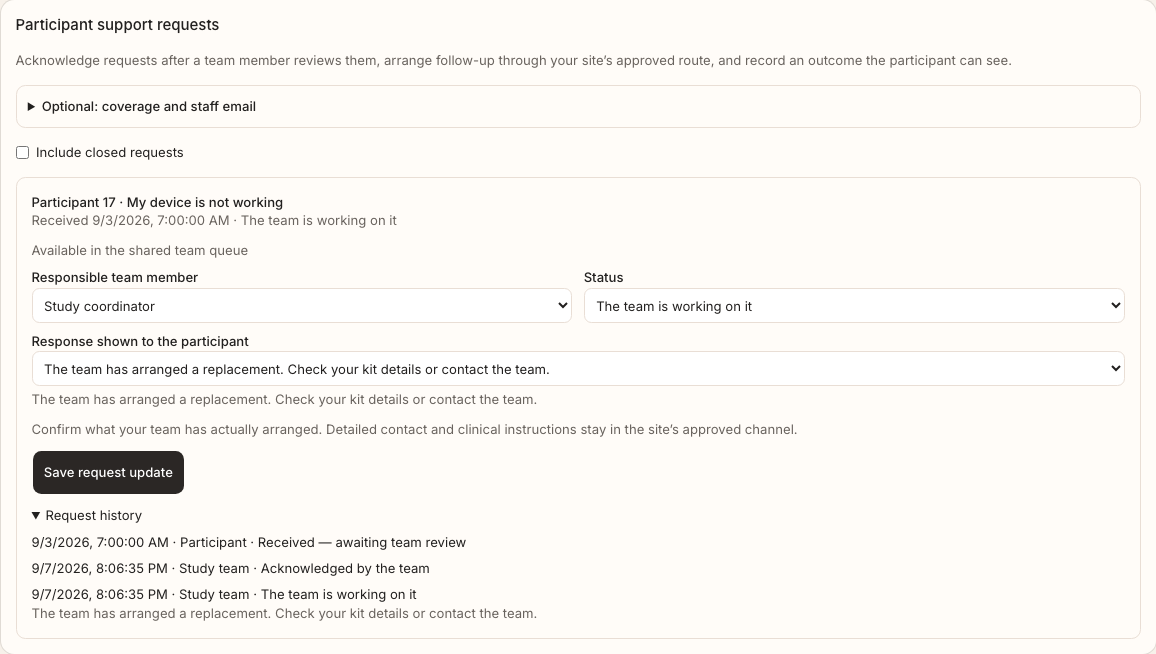
Help requests with a visible next step.

Give routine requests an owner, acknowledgment, status, and outcome. Participants can follow progress and reopen a request when they still need help.

Device, visit, kit, callback, and study questions stay distinct from urgent safety reporting. Staff email requires a configured delivery service.

Development preview of the actual Study Builder, with selectable participant activities and a weekly check-in schedule
Study Builder · Development screenshot, September 7, 2026. Synthetic study data. Select to enlarge.
Development preview of the actual participant support queue showing an assigned request, a participant response, and request history
Participant support · Development screenshot, September 7, 2026. Synthetic study data. Select to enlarge.

Before you plan your study

Make the fit explicit.

Integrations

Built-in health sharing uses Apple Health and Health Connect. EHR, laboratory, EDC, courier, and provider-calendar connections require separate scoping; named vendor connectors are not included in this preview.

Study qualification

Audit trails, consent workflows, and exports support study processes. They do not certify regulatory compliance. Sponsors and sites must qualify their intended use, approvals, and operating procedures.

Participation options

Browser-compatible studies support participation without an install. Some activities and native health-data collection require the mobile app. Available options depend on the study; provider arrangements remain site-coordinated.

Read the product guides →