Design and test
Configure protocol versions, assessments, consent, and study schedules. Use the draft-study sandbox with invited testers before publication.
Read the guide : Design and test ↗For researchers
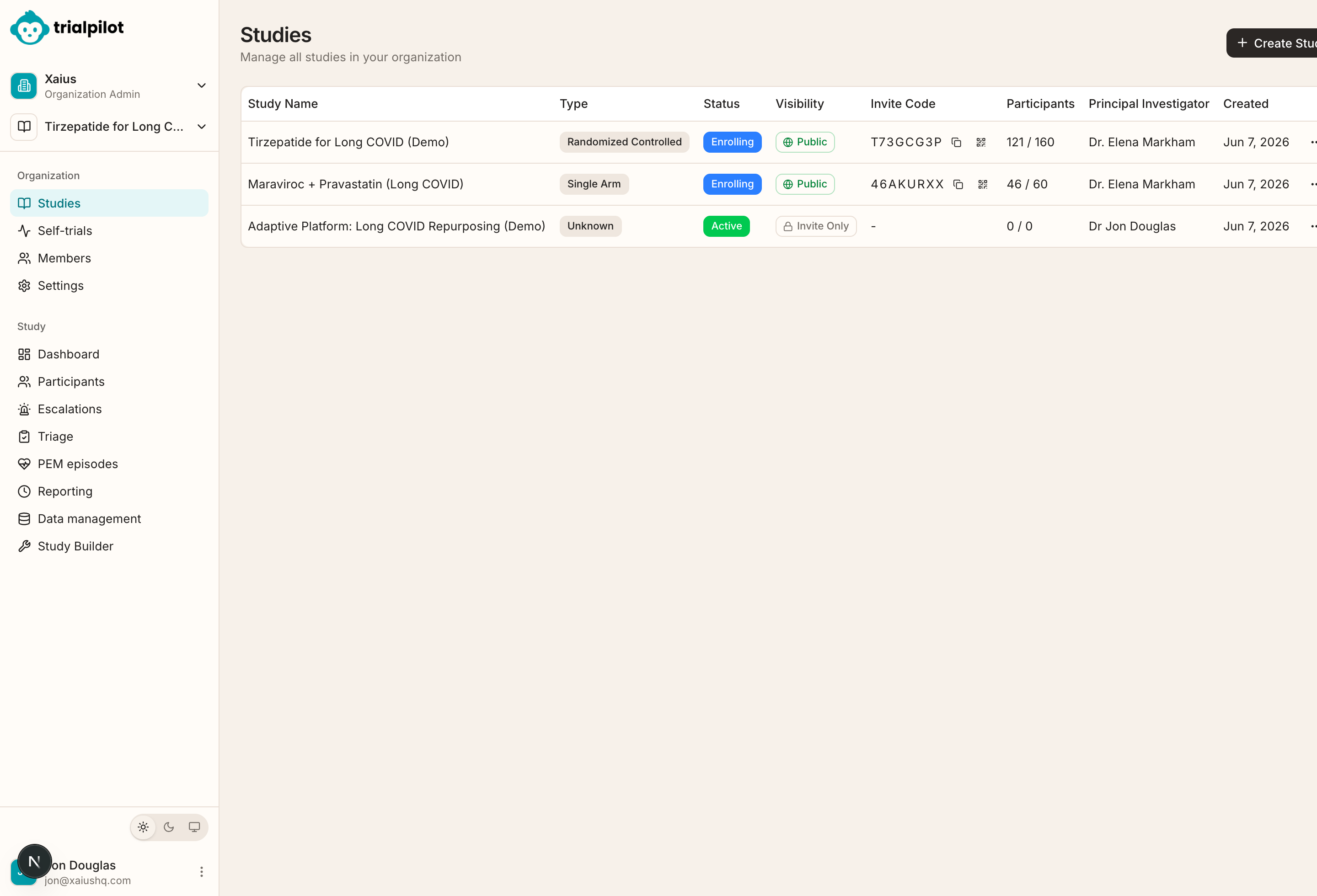
Connect recruitment, participant follow-up, and real-world data with adaptive designs, audit records, and supported CDISC exports. One workspace brings the study together; your team qualifies the protocol, operating procedures, and outputs for its intended use.
Product preview. Screens are illustrative; study teams qualify capabilities for their intended use.
Why teams switch
Bring study links, eligibility checks, and coordinator review into one enrollment flow. Recruitment speed still depends on the protocol, population, and outreach.
Engagement views highlight completion and missing-data patterns so coordinators can plan follow-up. A signal does not establish that someone will drop out.
Offer eligible participants activities closer to home and plan for device, language, and support needs. Broader access is a design goal; representation must be measured.
Supported health records and check-ins add context between visits. Coverage and freshness depend on devices, permissions, synchronization, and the study’s measures.
Three ways to generate evidence
Placebo-controlled, observational, or n = 1 — every design has its own protocol and oversight needs. Explore the shared study tools and confirm which workflows fit your intended use.
Randomized · Placebo-controlled
Support interventional studies with kit and lot records, delivery exceptions, receipt confirmation, and reconciliation. Teams and fulfillment partners arrange shipping. Randomization and blinding controls follow the study design; visits and oversight remain protocol-specific.
Observational · Real-world evidence
Enroll eligible patients taking a therapy chosen with their clinician. Collect repeated check-ins and supported health records while treatment decisions remain with their care team. The protocol defines the observational question and participant requirements.
N-of-1 · Single subject
Patients can define a personal question, collect repeated observations, and read single-subject analyses with uncertainty. Sharing is optional where supported. Personal self-trials do not establish treatment effectiveness or replace investigator-supervised trials.
There is more. See how a kit-based specimen study works, or how we support Long COVID research specifically.
One command center
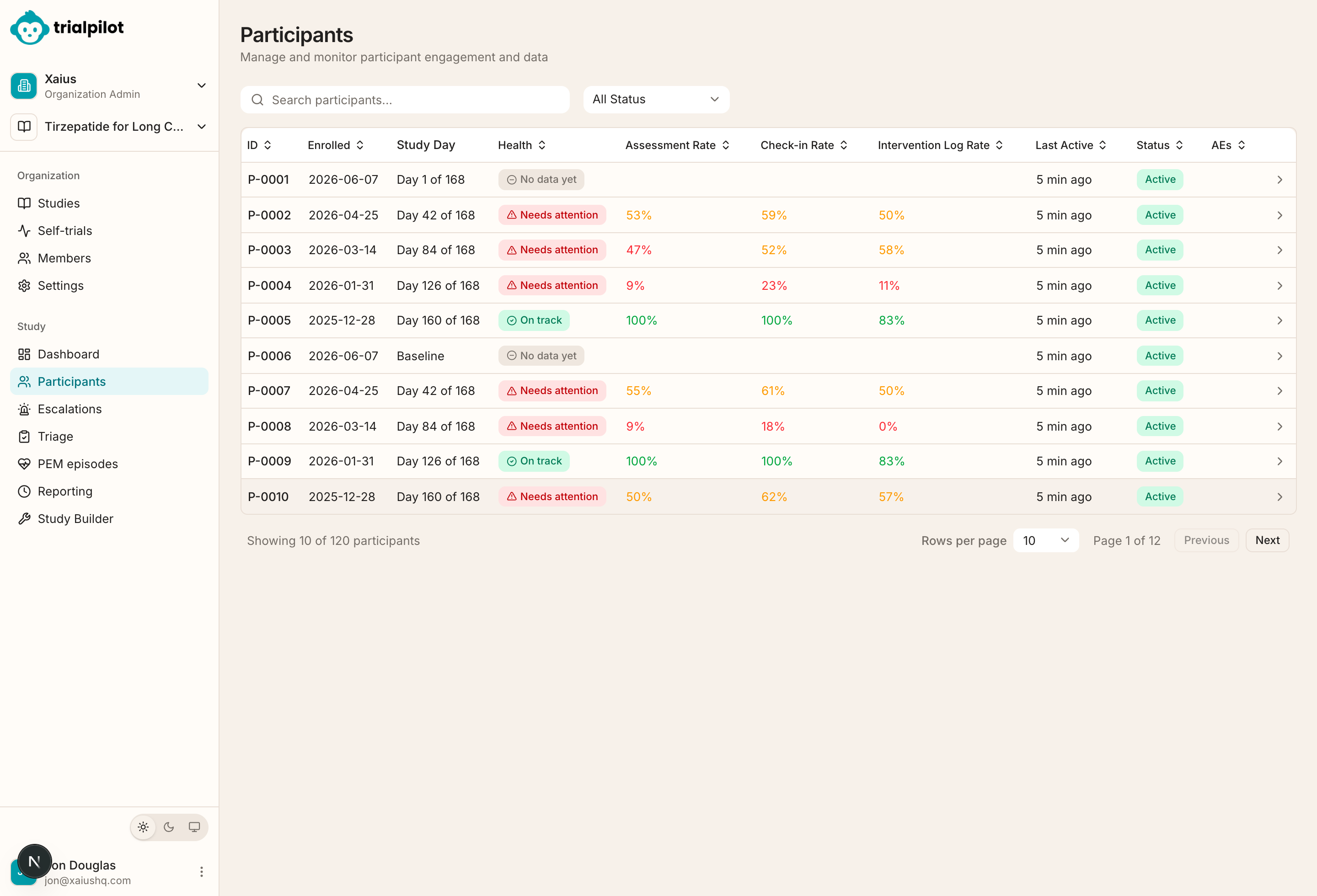
Enrollment, engagement, completion, and safety across the cohort — live, in one place. The same data your participants generate on their phones, as it synchronizes. Review freshness and missing-data context before interpreting a change.
The serious machinery
Explore recruitment, operations, monitoring, managed data, and exports in one connected study lifecycle. Review each capability with your team’s protocol and procedures before relying on it in a trial.
Channel-aware recruitment, remote self-screening, and coordinator verification work as one funnel. Staff can decide the criteria they own without seeing participant identity or private answers.
Manage products, lots, kits, delivery exceptions, receipt confirmation, returns, and final disposition. Every kit stays explainable through the reconciliation report.
A written monitoring plan, protocol deviations, live risk indicators, and a machine-inventoried audit package give monitors the evidence they need while preserving blinding and de-identification.
Launch readiness, immutable protocol versions, trial-registration clocks, milestones, results reporting, closeout checks, and a verifiable archive stay connected to the same study state.
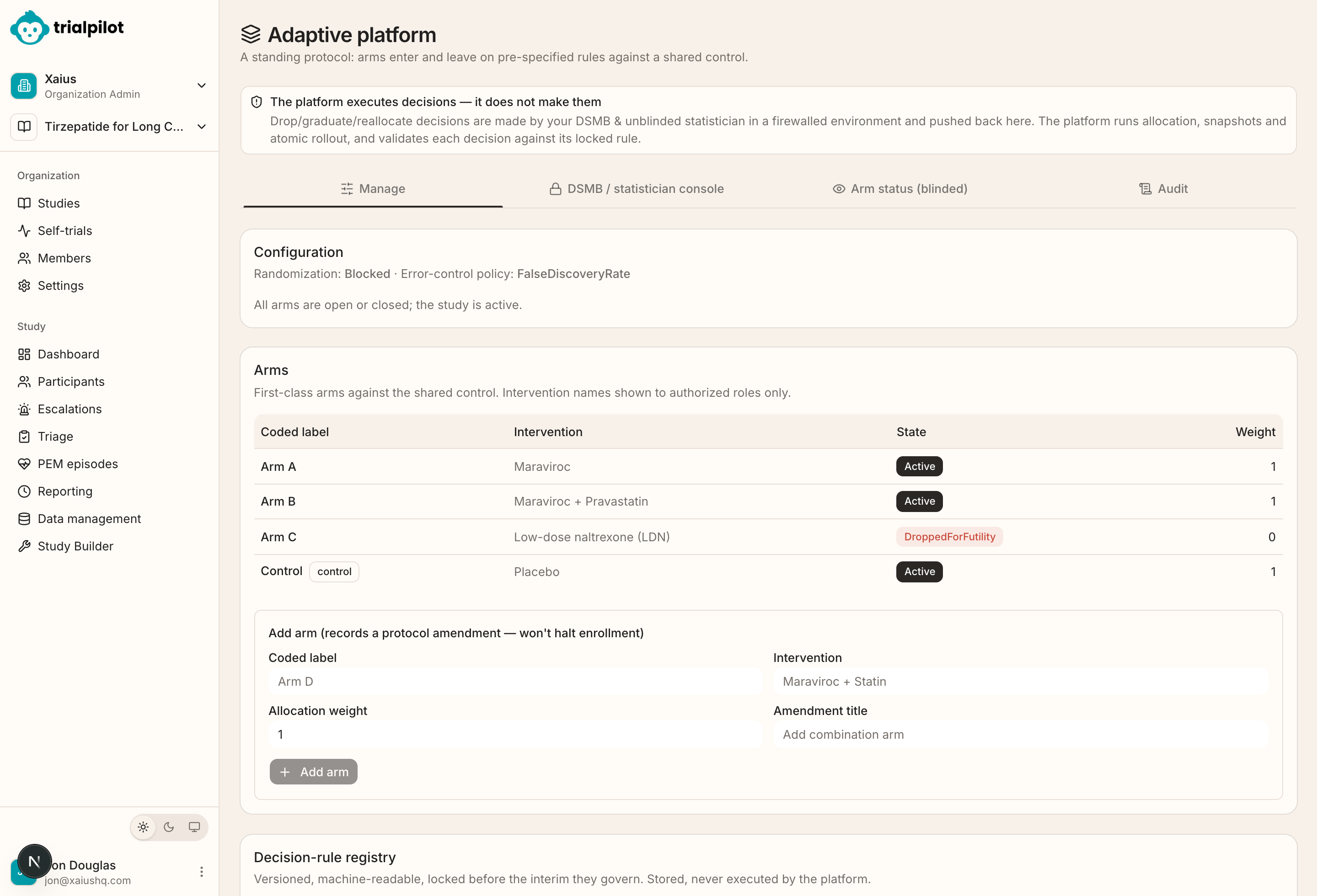
Perpetual, multi-arm designs with deterministic randomization, response-adaptive allocation inside preset guardrails, factorial domains, and a blinding firewall.
A versioned, audited managed dataset with an edit-check engine and query workflow — discrepancies resolved in the flow, not in a spreadsheet months later.
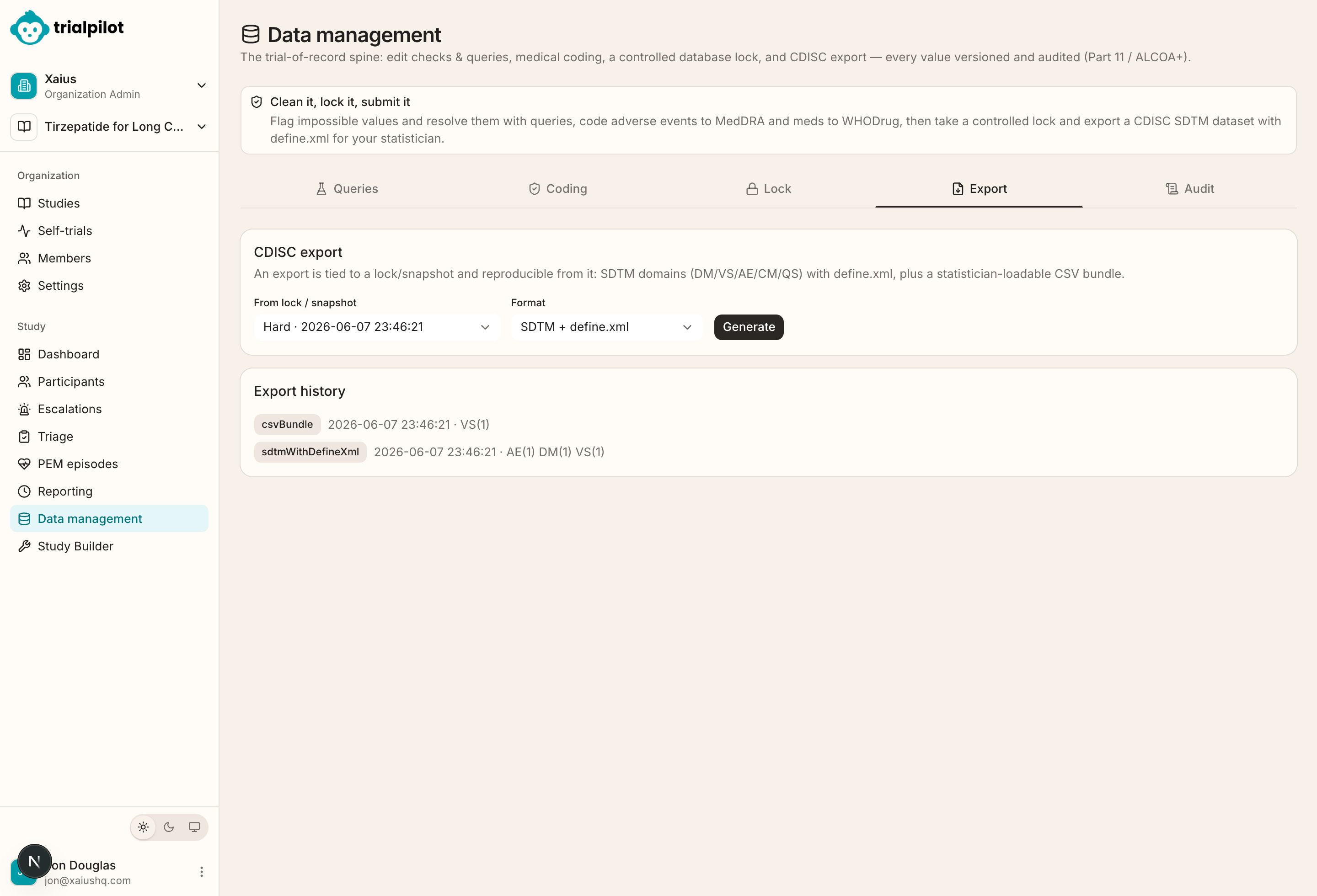
Coding review, soft and hard database locks with audited unlock, and supported CDISC SDTM + define.xml exports. Licensed MedDRA and WHODrug dictionaries are not connected in the preview; validate outputs for your study.
Safety workflows bring participant reports and available data to study-team review, with recorded escalation and follow-up. Response times depend on the study’s procedures and staffing.
Plan connections to research tooling around the available APIs and export formats. EHR, laboratory, and vendor connections require separate integration work and validation.
Participant identity lives apart from clinical data at the database boundary. De-identified coordinator views and role permissions limit access within a study.
The evidence
We don’t make claims we can’t back up.
Explore published work on enrollment, retention, representation, cost, and safety, with the study examples and their limits in context. These are external research findings, not measured TrialPilot outcomes.
Describe focus symptoms alongside the condition, remote and local-service arrangements, the typical and busiest weeks, and practical support. Explain which personal trends, individual test results, and overall findings you plan to return. Distinguish assessment channels from reminders. Discuss travel, waiting, sample handling, and recovery with participants; scheduled activity estimates cannot capture all of that time.
Explore the details
Configure protocol versions, assessments, consent, and study schedules. Use the draft-study sandbox with invited testers before publication.
Read the guide : Design and test ↗Manage recruitment, monitor completion and missing data, and follow supplies or specimen records within the study’s approved design.
Read the guide : Coordinate participation ↗Trial Signal brings study-level observations and uncertainty together. Access follows blinding rules; public signals require eligibility and explicit publication.
Read the guide : Review with confidence intervals ↗Work through queries, coding review, locks, and supported CDISC outputs. Licensed dictionaries require separate connections; validate outputs for your intended use.
Read the guide : Data review and export ↗Coordinate single-timepoint collection, chain-of-custody records, accessioning, and appropriate result return. A workflow is distinct from a live vendor integration.
Read the guide : Specimen studies ↗Study-scoped identifiers, de-identified coordinator views, and role permissions define who can access study information.
Read the guide : Privacy and permissions ↗Coming next
A look at the next participant experience. These features are in development and are not yet released.
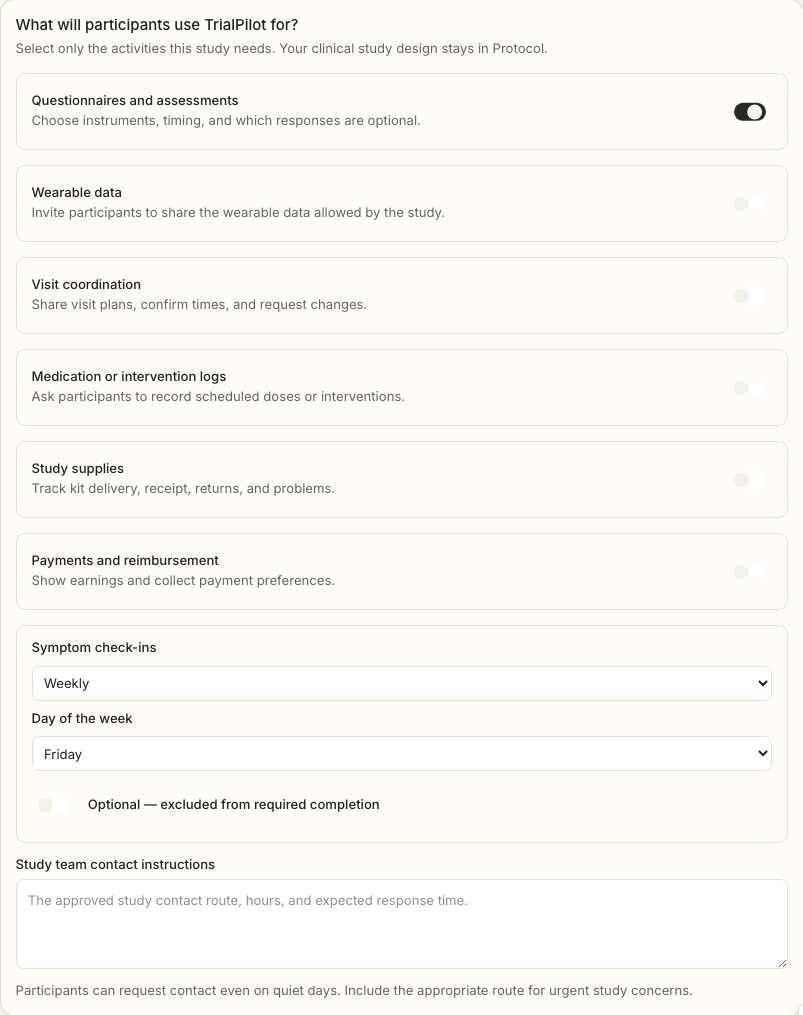
Configure questionnaires, check-ins, wearable sharing, visits, intervention logs, supplies, and payments. Optional work stays separate from required completion.
Sites can also link an already-enrolled participant to an approved app activity plan while preserving their original study timeline.
See what needs attention, what is coming up, what is waiting, and what is complete. Quiet weeks stay quiet, and saved-on-device work is clearly labeled until received.
The plan brings assigned activities, visits, kit updates, payment records, routine help requests, and released summaries together.
Offer approved home, site, or local-provider visit options. Participants can request an available alternative for the team to arrange.
Completed questionnaires stay complete when an arrangement changes. Provider availability and clinical suitability are confirmed by the site.
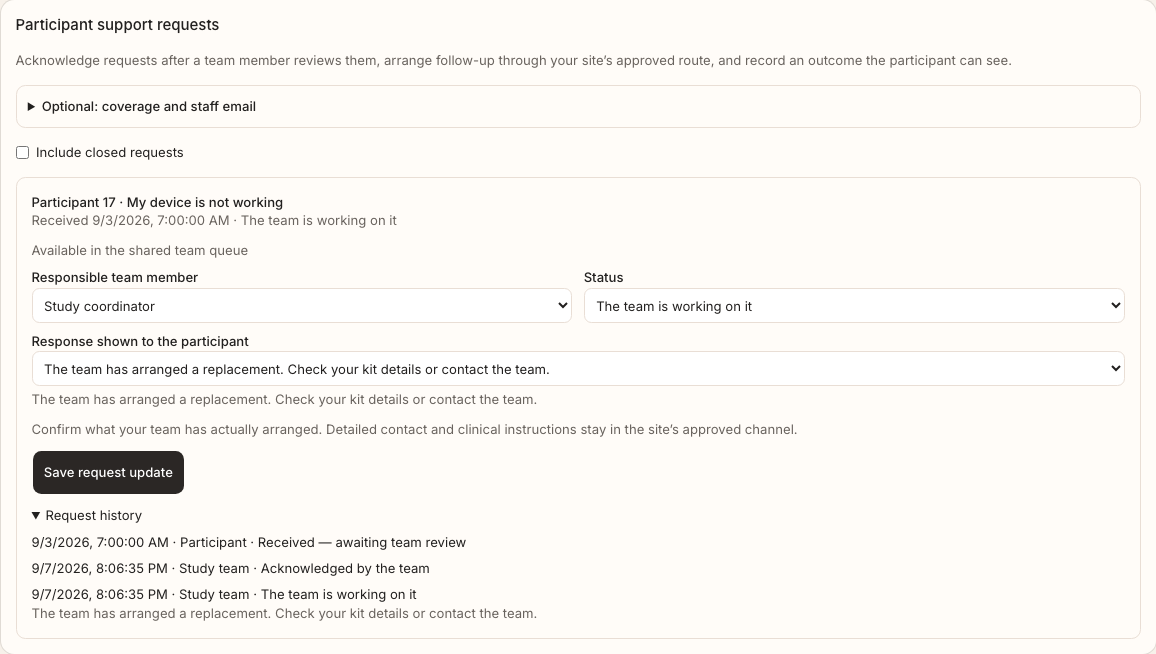
Give routine requests an owner, acknowledgment, status, and outcome. Participants can follow progress and reopen a request when they still need help.
Device, visit, kit, callback, and study questions stay distinct from urgent safety reporting. Staff email requires a configured delivery service.